Artificial intelligence company Anthropic made its Nasdaq debut on November 19 under the ticker ANT. Shares were priced at USD 83 in the IPO, but the first trade took place at USD 111.50 - more than 34% higher. That price sets high expectations: Claude’s rapid adoption needs to drive revenue growth and deliver lasting profits.
What Anthropic does
Anthropic was founded in 2021 by a team that included former OpenAI employees and siblings Dario and Daniela Amodei, who still lead the company. Dario serves as CEO and Daniela as president. Their aim is to develop AI whose behaviour is easier to guide and whose results are more reliable. The company also has an Estonian connection: Jaan Tallinn led its USD 124 million funding round that same year.
Under the Claude name, Anthropic offers AI models, a conversational assistant and applications designed for specific tasks. Claude Code helps developers write and review code, while Cowork supports office work. An application programming interface, or API, lets businesses integrate Claude into their own applications. Anthropic earns money through subscriptions and usage-based fees.
PwC, for example, has described using Claude to prepare journal entries, analyse financial data and support planning. If employees find that it saves them time, the business has a reason to give AI more tasks. An initial trial can then become part of everyday work, allowing Anthropic to grow as its customers use the service more.
Rapid growth comes at a cost
Anthropic’s results show how quickly this kind of business can expand. In the first nine months of 2026, the company generated USD 33.2 billion in revenue, roughly 13 times the amount a year earlier. Third-quarter revenue alone reached almost USD 17 billion. Yet this rapid growth has not produced an operating profit: the nine-month operating loss was USD 1.3 billion.
One of the company’s largest expenses is computing power, which is needed both to train models and to handle customers’ daily tasks. Spending on computing and infrastructure reached USD 18.8 billion over the nine-month period, equivalent to about USD 57 for every USD 100 of revenue. The remainder still has to cover salaries and other operating expenses.
More efficient models and cheaper infrastructure contracts can reduce the cost of doing the same work. But those savings will not necessarily turn into profit. Competition may force Anthropic to lower its prices, passing some of the benefit on to customers. Its profitability therefore depends both on controlling costs and on how much customers are willing to pay.
The price assumes several more years of rapid growth
At the IPO price, Anthropic’s fully diluted equity value was approximately USD 1.5 trillion. At the opening trade price, it was already around USD 2 trillion. A fully diluted valuation includes shares that could be issued in the future, for example through employee stock options.
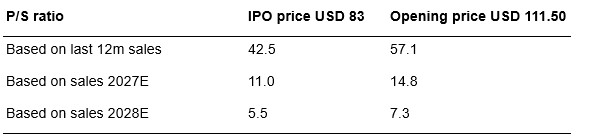
Comparing that valuation with revenue helps put the price into perspective. Revenue for the 12 months ended September was approximately USD 35.3 billion, giving Anthropic a price-to-sales ratio, or P/S, of about 42.5 at the IPO price. At the opening price, investors were paying roughly USD 57 for every dollar of revenue generated over that period. To justify that valuation, the business needs to become much larger.
Analysts at major banks do expect steep growth over the next few years. Revenue forecasts range from USD 52–53 billion this year to USD 135–137 billion in 2027 and USD 270–280 billion in 2028. That implies a compound annual revenue growth rate of around 129%.
Using the midpoints of those forecasts, revenue would need to increase more than fivefold in two years. Claude will have to reach new customers, while existing users will need to entrust it with more work. Beyond coding, potential areas for growth include financial analysis, document-related tasks and the automation of business processes. The lower future valuation multiples shown in the table depend on that expected growth actually materialising.
Infrastructure contracts create long-term commitments
Meeting those growth expectations depends largely on Claude’s ability to hold its ground against competitors. Anthropic competes with companies including OpenAI and Google, and a technological lead can change hands quickly. If customers find a cheaper or better way to do the same work, keeping them may require price cuts, slowing the improvement in profitability.
At the same time, Anthropic has committed to infrastructure whose costs cannot be reduced as quickly. According to its IPO prospectus, contractual commitments, mainly related to computing capacity and infrastructure, total approximately USD 901 billion. These are spread over many years, with a substantial portion extending through 2045. Around USD 70.7 billion, however, is due in the 12 months following September 30, 2026. Long-term contracts help secure the capacity the company needs, but they also create costs even if demand falls short of expectations.
When reading Anthropic’s next financial reports, investors should watch computing costs per dollar of revenue alongside revenue growth. If that cost falls while customer engagement increases, the company will have a better chance of turning rapid growth into lasting profits.
This article is for informational purposes only and should not be construed as investment analysis or a recommendation to buy or sell the securities mentioned. LHV is not liable for any decisions made based on this information.
Investing involves both opportunities and risks; the market value of securities may rise or fall. In foreign markets, returns may be affected by fluctuations in exchange rates.
The past or future performance of the securities and financial indices discussed above does not constitute a promise or indication of future performance.