
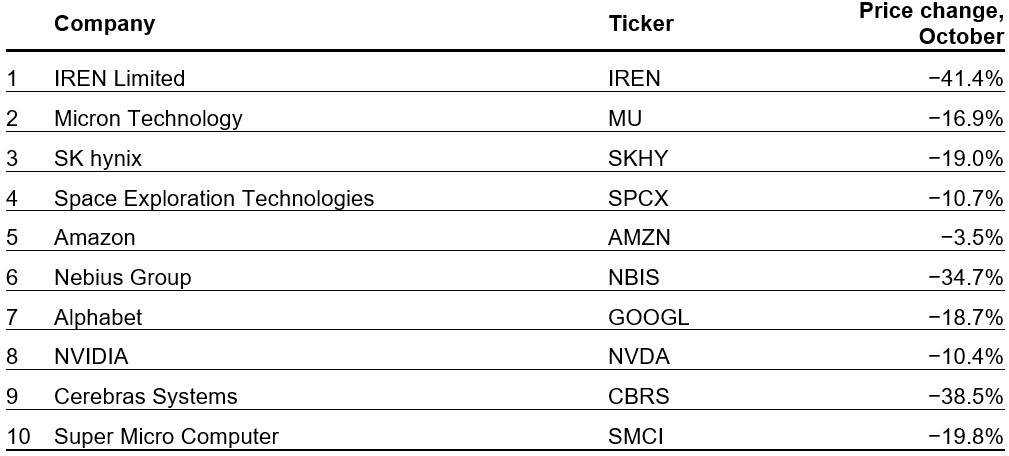
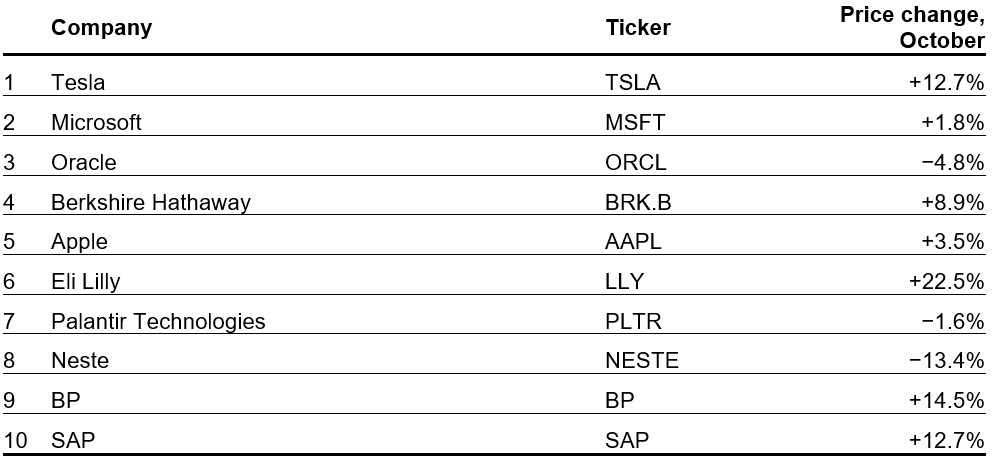
IREN topped LHV clients’ buy list in October, followed by memory chipmakers Micron and SK hynix. SpaceX, Amazon and NVIDIA also ranked among the ten most-bought stocks. Tesla led the sell list, ahead of Microsoft and Oracle. Drugmaker Eli Lilly and energy companies Neste and BP joined the technology companies among the ten most-sold stocks.
Most-bought in October
Source: LHV, Bloomberg
IREN Limited (IREN, −41.4%)
Concerns about the cost of financing AI infrastructure weighed on IREN throughout October. The company announced plans for a 300-megawatt data centre in Spain on 21 October and a $363 million equipment financing deal on 28 October. Investors’ growing caution about capital-intensive cloud providers outweighed the expansion news. IREN fell nearly 9% on each of the final two trading days, recording the steepest monthly decline on the buy list.
Micron Technology (MU, −16.9%)
Competition in the memory chip market and uncertainty over production weighed on Micron in October. On 12 October, market reports highlighted advances by Chinese rival CXMT and a profit-sharing dispute that raised the prospect of a strike at Micron’s facilities in Taiwan. A broader chip sell-off added to the pressure late in the month as investors questioned the returns on AI investment. Although demand remained strong, pricing pressure and customers’ ability to fund future purchases became greater concerns.
SK hynix (SKHY, −19.0%)
SK hynix ended October lower despite a sharp rebound after its results on 28 October. Sales of memory chips for AI applications and higher prices helped lift quarterly revenue to a record 104.6 trillion won and operating profit to 83.3 trillion won. The company also announced substantial dividends and share buybacks. Its US-listed shares rose 13.3% on the day of the announcement, but a drop of nearly 8% on the final trading day reflected lingering caution about the sector.
Space Exploration Technologies (SPCX, −10.7%)
SpaceX reported on 20 October that quarterly revenue had risen 161% year on year to $14.6 billion, while net income reached $4.4 billion. A possible merger with Tesla also came into focus. Both companies formed special committees to assess a deal, although they had yet to reach an agreement. SpaceX shares rose 7.8% on 21 October, but subsequent losses erased the gain and left the stock lower for the month.
Amazon (AMZN, −3.5%)
Morgan Stanley’s upbeat assessment of Amazon Web Services helped lift Amazon shares mid-month. The results released on 29 October showed both how quickly the cloud business was growing and how much Amazon was spending to support it. Quarterly revenue rose 12% to $201.9 billion, while AWS revenue grew 39% to $46 billion. Spending on AI helped push free cash flow to negative $42.4 billion over the preceding 12 months. The shares fell 1.4% on the trading day after the announcement and ended October lower.
Nebius Group (NBIS, −34.7%)
Nebius fell alongside other AI cloud providers as investors turned their attention from the pace of growth to the cost of funding it. On 22 October, the company announced a $3.5 billion financing agreement with Citi to expand its data centres and computing capacity. The deal gave Nebius more flexibility in the near term, though its expansion still requires substantial capital. A further 10.4% drop on the final trading day took the monthly loss to more than a third.
Alphabet (GOOGL, −18.7%)
Alphabet’s results on 28 October showed how quickly revenue could grow even as cash flowed out of the business. Revenue rose 25% to $127.6 billion, below analysts’ expectations, while free cash flow was approximately negative $9.1 billion for the quarter. Weaker-than-expected advertising results and heavy AI spending triggered a sell-off. The shares fell 12.6% in regular trading on 29 October, taking the monthly decline to nearly a fifth.
NVIDIA (NVDA, −10.4%)
NVIDIA shares came under pressure as investors questioned whether customers could keep financing AI infrastructure at the same pace. Mid-month market reports linked selling across the chip sector partly to rising yields on CoreWeave’s bonds and the higher cost of borrowing. NVIDIA fell another 4.2% on the final trading day after results from Amazon and Intel deepened doubts about the returns on AI spending. For NVIDIA, much depends on whether customers can turn ambitious spending plans into chip orders as financing becomes more expensive.
Cerebras Systems (CBRS, −38.5%)
Cerebras recorded one of the steepest declines on the buy list, despite encouraging news late in the month. On 27 October, the company announced a partnership to bring its technology for running AI models to Oracle’s cloud infrastructure. The shares jumped 10.1% that day, but the rally faded. The agreement broadened Cerebras’s commercial opportunities without reversing the losses the stock had already sustained.
Super Micro Computer (SMCI, −19.8%)
In a preliminary business update on 20 October, Super Micro Computer raised its quarterly revenue outlook, citing demand for its AI systems. The shares rose 9.6% the following day, when the company also unveiled a liquid-cooled server system built around NVIDIA Vera processors. The recovery proved short-lived. Renewed selling late in the month left the server maker’s shares down nearly a fifth in October.
Explore up to five years of share price history for IREN Limited (IREN), Micron Technology Inc (MU), SK Hynix Inc (SKHY), Space Exploration Technologies (SPCX), Amazon.com, Inc. (AMZN), Nebius Group N.V. (NBIS), Alphabet, Inc. (GOOGL), NVIDIA Corporation (NVDA), Cerebras Systems (CBRS), SuperMicro Computer (SMCI).
Most-sold in October
Source: LHV, Bloomberg
Tesla (TSLA, +12.7%)
A possible merger with SpaceX dominated the news around Tesla in October. In a regulatory filing, Tesla confirmed that it had formed a special committee to explore a deal and stressed that the outcome remained uncertain. Market reports on 21 October linked the rise in Tesla shares to expectations of a merger. The business itself delivered more modest results. Quarterly revenue held at around $28 billion, and net income attributable to shareholders fell even as hopes of a deal lifted the stock.
Microsoft (MSFT, +1.8%)
Microsoft reported results for its fiscal first quarter on 28 October. Revenue rose 19% to $92.3 billion, and cloud revenue grew 30% to $63.9 billion. Those figures showed strong demand for Microsoft’s cloud services, though the shares struggled to build on their earlier gains. They fell 0.2% on 29 October and a further 1.6% on the final trading day as concerns about returns on AI investment weighed on technology stocks. Microsoft still finished October modestly higher.
Oracle (ORCL, −4.8%)
Oracle set out its financing plans at its investor day on 28 October. Management expected free cash flow to turn positive in the second half of fiscal 2028 and said it would cap additional fundraising through fiscal 2030 at $20 billion, excluding the refinancing of existing debt. The clearer funding outlook eased investors’ concerns, sending the shares up 10.7% that day. Losses over the final two trading days erased the rally, leaving Oracle down for the month.
Berkshire Hathaway (BRK.B, +8.9%)
Berkshire Hathaway shares continued to recover in October. Market coverage on 21 October pointed to growing investor confidence in Greg Abel’s leadership, with particular attention on how he would put Berkshire’s substantial cash reserves to work. The company’s next quarterly results were due in November. While many technology stocks fell back late in October, Berkshire held on to most of its gains.
Apple (AAPL, +3.5%)
October brought mixed signals about iPhone demand. On 9 October, Reuters cited a Nikkei report that Apple had cut component orders for its Pro models, a claim Reuters could not independently verify. Later in the month, Counterpoint estimated that early sales of the Pro series had risen 3.1%, with strength in China offsetting weakness in the US and Japan. Apple shares ended October higher, although demand varied considerably by market.
Eli Lilly (LLY, +22.5%)
Eli Lilly reported on 29 October that strong demand for Mounjaro and Zepbound had lifted quarterly revenue 39% to $24.4 billion. The company raised its full-year revenue forecast to $91–92 billion, although charges for acquired research and development reduced its adjusted earnings forecast. Investors focused on strong sales and the improved revenue outlook. The shares rose 6.6% on the day of the results and another 3.2% the following day, giving Lilly the largest monthly gain on the sell list.
Palantir Technologies (PLTR, −1.6%)
Palantir shares gained support in the first half of October when Goldman Sachs upgraded the stock from Neutral to Buy and set a $230 price target. In its 9 October assessment, the bank highlighted governments’ need for AI systems they could control themselves. The broader technology sell-off reversed those gains late in the month. Palantir fell 6.3% on 30 October and finished October slightly lower.
Neste (NESTE, −13.4%)
Neste’s results on 29 October showed a sharp improvement in earnings. Comparable EBITDA, a measure of operating earnings before depreciation and amortisation, rose from €531 million to €1.56 billion, supported by renewable fuel sales and high refining margins. Neste also announced a new dividend policy targeting a payout of 20–40% of annual earnings per share. Despite the earnings improvement, the shares fell 3.2% that day. Management warned of continued market volatility and upcoming maintenance shutdowns, though no single factor clearly accounts for the full month’s decline.
BP (BP, +14.5%)
High energy prices and refining margins improved BP’s earnings outlook and supported its shares in October. The results on 30 October confirmed a strong quarter. Underlying replacement cost profit, BP’s preferred earnings measure, rose from $2.21 billion a year earlier to $8.46 billion, beating analysts’ expectations. Net debt fell to $13.9 billion. Management said it would use surplus cash to reduce debt and settle liabilities from the Deepwater Horizon disaster. The shares edged higher on the day, with most of their monthly gain already in place.
SAP (SAP, +12.7%)
SAP shares drew support from the third-quarter results released on 21 October. Cloud revenue rose 26%, and the current cloud backlog, which measures contracted cloud sales expected to become revenue in the near term, grew 28% to €24.1 billion. The figures reinforced expectations that customers would continue moving to SAP’s cloud services. Its US-listed shares rose 3.4% on 22 October.
Explore up to five years of share price history for Tesla (TSLA), Microsoft Corporation (MSFT), Oracle Corporation (ORCL), Berkshire Hathaway (BRKB), Apple (AAPL), Eli Lilly and Company (LLY), Palantir Technologies (PLTR), Neste Corporation (NESTE), BP PLC (BP), SAP AG (SAP).
This article is for informational purposes only and should not be construed as investment analysis or a recommendation to buy or sell the securities mentioned. LHV is not liable for any decisions made based on this information.
Investing involves both opportunities and risks; the market value of securities may rise or fall. In foreign markets, returns may be affected by fluctuations in exchange rates.
The past or future performance of the securities and financial indices discussed above does not constitute a promise or indication of future performance.